The Open-Source AI Landscape in 2026
Two years ago, running a capable language model locally was a project for researchers with beefy GPU clusters. Today, you can pull a model with Ollama, run it on a MacBook Pro or a mid-range Windows machine, and get genuinely useful responses within minutes. The gap between open-source and proprietary AI has narrowed dramatically — but it hasn't closed.
The most important open-source models right now include Meta's Llama 4 series (the benchmark for raw open-source capability), DeepSeek V3 and R1 (genuinely competitive with frontier closed models on reasoning, especially R1's chain-of-thought capability), Alibaba's Qwen 3 (excellent multilingual support and very strong on coding tasks), Mistral Large 2 and Mistral Small 3 (exceptionally efficient for their size), Google's Gemma 3 (strong on reasoning tasks), and Microsoft's Phi-4 (tiny models punching well above their weight on structured tasks). Tools like Ollama, LM Studio, and Jan have made running these models as easy as installing an app.
On the cloud side, the main contenders are Claude 4 (Anthropic — Opus 4.7, Sonnet 4.6, Haiku 4.5), GPT-5 (OpenAI), and Gemini 2.5 (Google). These are larger, more capable models backed by significant ongoing investment — and they come with API access, reliability guarantees, and continuous improvement.
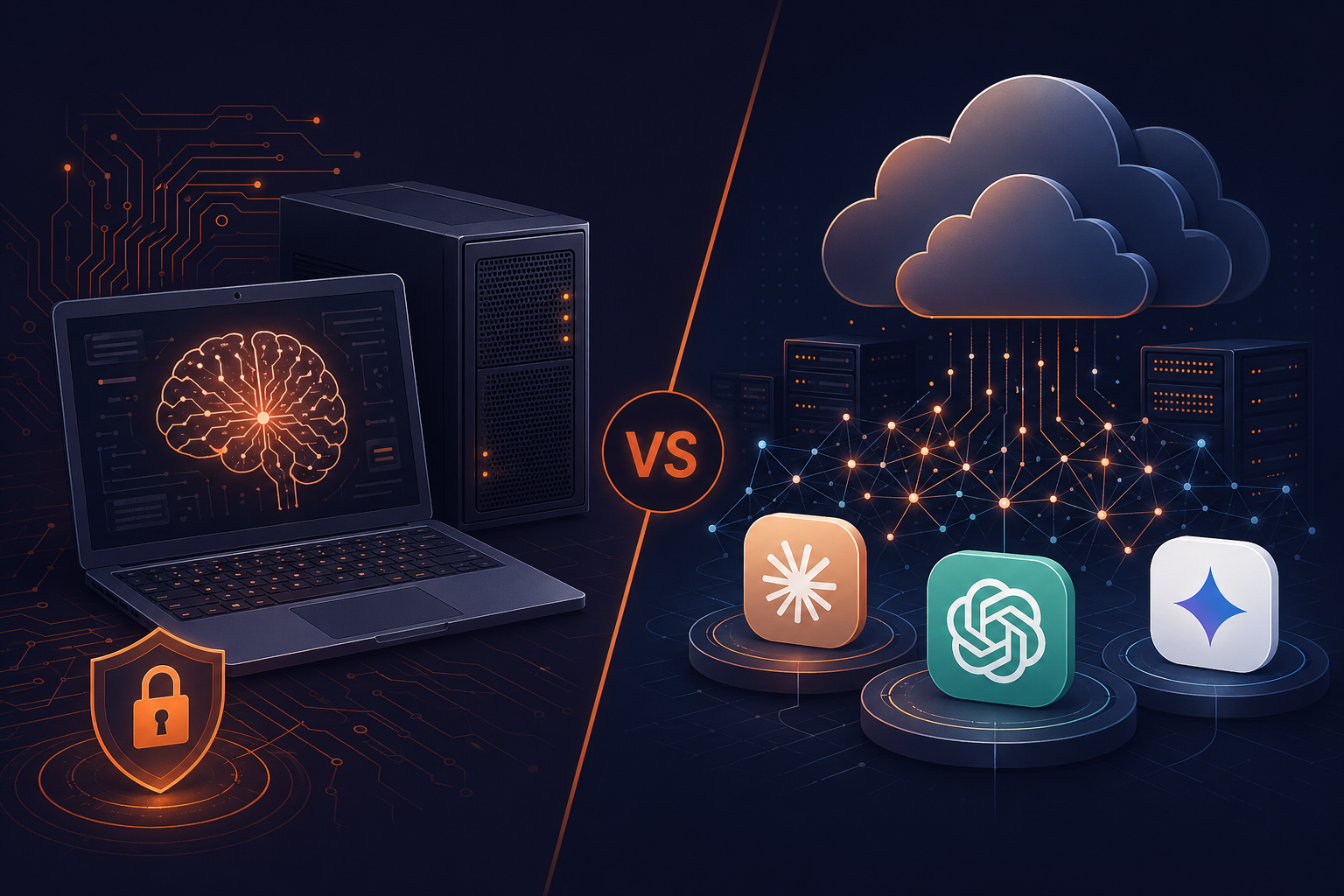
Local LLMs win on privacy, cost at scale, and offline use. Cloud AI wins on raw capability, reliability, multimodal features, and ease of integration. For most businesses, the answer isn't either/or — it's knowing which tasks to route where.
Head-to-Head: Local LLMs vs Cloud AI
| Factor | Local LLMs (Llama, Mistral, etc.) | Claude / ChatGPT / Gemini |
|---|---|---|
| Raw capability | Strong — DeepSeek R1 and Llama 4 close the gap considerably on many tasks | Excellent — Claude 4 and GPT-5 still lead on complex reasoning |
| Privacy / data control | Full control — data never leaves your machine | Data sent to third-party servers (check ToS for your use case) |
| Cost at scale | Near-zero per query after hardware investment | Per-token pricing adds up at high volume |
| Setup complexity | Moderate — Ollama makes it easier but still requires configuration | Minimal — API key and you're running |
| Hardware requirements | Significant — 16GB+ RAM for good models, GPU helps a lot | None — runs in the cloud |
| Context window | 128K tokens common; some models (Llama 4, Qwen 3) reach 1M+ | 200K tokens (Claude 4), 400K+ (GPT-5), 2M (Gemini 2.5) |
| Multimodal (images, audio) | Limited — some models support vision, fewer support audio | Full multimodal support across most flagship models |
| Offline use | Works fully offline | Requires internet connection |
| Fine-tuning / customisation | Full access — fine-tune on your own data | Limited fine-tuning via API (OpenAI); not available for Claude |
| Reliability / uptime | Depends on your infrastructure | Enterprise SLAs, 99.9%+ uptime |
Where Local LLMs Have a Genuine Edge
Sensitive data and regulatory compliance
This is the clearest win for local models. If your business handles patient records, legal documents, financial data, or anything subject to GDPR, HIPAA, or financial regulations — sending that data to a third-party API is a compliance minefield. A locally-run model processes everything on your infrastructure, with no data leaving your perimeter. For sectors like healthcare, legal, and finance, this alone can be the deciding factor.
High-volume, low-complexity tasks
If you're processing thousands of documents per day — classifying support tickets, extracting structured data from forms, summarising short texts — the per-token cost of cloud AI adds up fast. A well-configured local model running on a dedicated server can handle the same workload at a fraction of the cost once the hardware is amortised. Mistral Small 3 or Qwen 3 8B, for instance, handle classification and extraction tasks remarkably well for their size and running cost.
Offline and edge deployments
Field teams, manufacturing floors, or any environment without reliable internet access need AI that works offline. Local LLMs are the only option here. A logistics company running route optimisation or a warehouse using AI-assisted inspection can't depend on an API call completing in 200ms from a remote server.
Full fine-tuning control
Open-source models can be fine-tuned on your specific data, terminology, and style. A legal firm can train a model on their precedents; a medical company on their clinical notes; a retailer on their product catalogue. The result is a model that speaks your language in a way no general-purpose cloud model can replicate without significant prompt engineering overhead.
Where Cloud AI (Claude, ChatGPT) Still Wins
Complex reasoning and multi-step tasks
On tasks that require genuine depth — nuanced analysis, multi-step planning, understanding ambiguous business requirements, or producing long-form content that holds together logically — frontier models like Claude Opus 4.7, Sonnet 4.6, and GPT-5 still outperform the best open-source alternatives by a meaningful margin. DeepSeek R1 has narrowed the gap on pure reasoning benchmarks, but for end-to-end agentic work the cloud frontier still leads.
Multimodal capabilities
If your workflow involves images, documents, screenshots, or audio, cloud AI is ahead. Claude 4 can analyse charts, read handwritten notes in images, and process complex visual data. GPT-5 handles vision, audio, and text natively, with real-time voice interaction. Gemini 2.5 leads on long-form video understanding. The open-source multimodal ecosystem is improving rapidly — Qwen 3-VL and Llama 4 multimodal variants are genuinely capable — but for production-grade multimodal pipelines, cloud models are still the safer bet.
Speed to production
Getting a cloud AI integration running takes an afternoon. Getting a local LLM into production — with proper inference infrastructure, model management, monitoring, and failover — takes weeks and requires meaningful DevOps investment. For businesses that need to move fast, the operational simplicity of an API is a significant advantage.
Continuous improvement without effort
Cloud AI models improve over time and you get the benefit automatically. When Anthropic ships a better Claude model, your integration upgrades with a version bump. With local models, staying current requires re-downloading, re-testing, and potentially re-fine-tuning — ongoing maintenance that has a real cost.
The Hybrid Approach: Routing Tasks Intelligently
The most sophisticated businesses aren't choosing one or the other — they're building routing layers that direct tasks to the right model based on sensitivity, complexity, and cost. The pattern looks like this:
- Sensitive data processing → local model (privacy preserved, cost-effective at scale)
- High-complexity reasoning → Claude Opus 4.7 or GPT-5 (best quality, worth the API cost)
- High-volume simple tasks → local model or a smaller cloud model like Claude Haiku 4.5 (cost-optimised)
- Multimodal tasks → cloud AI (superior capability)
- Customer-facing interactions → cloud AI (reliability and quality non-negotiable)
This hybrid architecture lets you optimise for cost where quality thresholds are lower, and invest in frontier AI where the task demands it. It's not about being loyal to one paradigm — it's about building systems that are economically intelligent.
Running local LLMs isn't free — it trades API costs for hardware, maintenance, DevOps overhead, and engineering time. For small businesses or early-stage products, cloud AI is almost always the cheaper option once total cost of ownership is factored in. Local models make economic sense at scale or where privacy is non-negotiable.
Which Models Should You Actually Consider?
If you go local
- Llama 4 (Maverick / Scout) — Meta's flagship open models. Maverick is the highest-quality open-source option for most business tasks; Scout is the smaller, faster sibling for resource-constrained setups.
- DeepSeek V3 / R1 — V3 is a fantastic general-purpose model; R1 is a chain-of-thought reasoning model that competes with frontier closed models on maths, coding, and logic-heavy tasks.
- Qwen 3 — Alibaba's lineup (from 4B up to 235B) is exceptional on multilingual tasks and coding. Qwen 3 8B is a strong default for many production workloads.
- Mistral Small 3 / Mistral Large 2 — Small 3 runs comfortably on consumer hardware; Large 2 is one of the best efficiency-per-parameter options at the high end.
- Gemma 3 — Google's open weights, strong reasoning, well-suited for document analysis and Q&A tasks.
- Phi-4 — Microsoft's small model continues to punch above its weight, particularly for edge deployments and structured extraction.
- Ollama — The easiest way to get any of the above running locally. One command to pull, one command to run.
If you go cloud
- Claude Sonnet 4.6 — Best balance of quality, speed, and cost for most business automation tasks. 200K context window is a genuine differentiator.
- Claude Opus 4.7 — Maximum reasoning quality. Use it where the task complexity justifies the higher cost.
- Claude Haiku 4.5 — Anthropic's small, fast model — great for high-volume, lower-complexity work where Sonnet would be overkill.
- GPT-5 — OpenAI's flagship. Strong all-rounder, excellent multimodal capability, deep integration with the Microsoft / Azure ecosystem.
- Gemini 2.5 Flash / Pro — Google's lineup. Flash is speed-optimised and well-priced for high volume; Pro leads on long-form video and massive context windows.
Key Takeaways
- Local LLMs have closed the gap significantly — DeepSeek R1 and Llama 4 are genuinely capable — but frontier cloud models (Claude 4, GPT-5) still lead on complex reasoning and multimodal tasks.
- Local models win on privacy, regulatory compliance, offline use, and cost at very high volumes.
- Cloud AI wins on capability, ease of integration, reliability, and multimodal support.
- The smartest approach for most businesses is a hybrid routing strategy — local for sensitive/high-volume tasks, cloud for complexity and quality.
- Running local LLMs has a real operational cost (hardware, DevOps, maintenance) that small teams often underestimate.
- Ollama + Llama 4 or Qwen 3 is the fastest path to a capable local setup; Claude Sonnet 4.6 is the best default for cloud-first automation work.